Suppression vs. Compartmentalization: The Executive’s Guide to Emotional Control
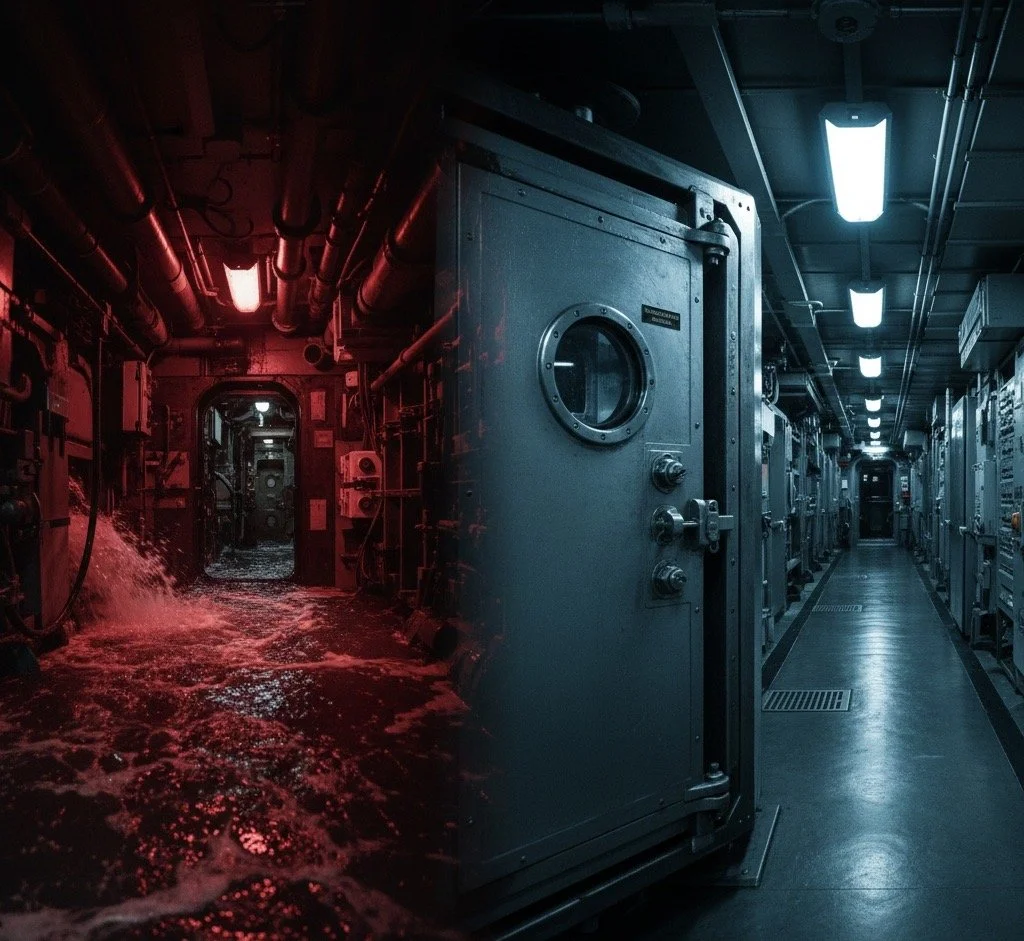
You are in a high-stakes negotiation. Or a quarterly board meeting. Or a crisis management call. Suddenly, a massive emotional spike hits you. It might be fear regarding the outcome. It might be rage at a partner’s incompetence. It might be grief from a personal loss.
Society tells you to "feel your feelings" in real-time. The Market tells you to be a robot and feel nothing.
Both are wrong.
If you break down in the boardroom, you lose the leverage. If you pretend you have no emotions, you eventually suffer a cardiac event at 45.
We need to make a critical distinction that most high-performing men miss. There is a difference between Suppression (System Error) and Compartmentalization (System Feature). One is a memory leak that crashes your operating system. The other is a superpower that allows you to function under fire.
Suppression (The System Error)
Most men try to be robots. They shove the emotion down the second it appears. This is Suppression. Suppression is the unconscious refusal to acknowledge the data. It is the act of holding a beach ball underwater.
You might look calm on the surface, but your internal CPU is running at 100% just to keep that ball submerged. This creates System Drag.
Symptom: You have unexplainable brain fog at 2 PM.
Symptom: You snap at your wife over a dishwasher loading error (leakage).
Symptom: You wake up at 3 AM with your heart racing because the firewall is down.
Suppression is a lie. You are pretending the signal doesn't exist. And systems built on lies eventually collapse.
Compartmentalization (The Feature)
Compartmentalization is different. It is a conscious, tactical choice. It is the ability to acknowledge the signal, tag it, and file it for later processing so you can execute the mission.
The Metaphor: The Submarine

Think of your mind as a submarine. When a sub takes a hit or encounters a breach, the captain does not ignore the water. That would sink the ship. Instead, he orders the crew to seal the watertight doors. He isolates the flooded compartment. "We have water in Sector 4. Seal it off. We will deal with it when we surface. Right now, we have a war to fight."
This is Compartmentalization. It sounds like this in your head: "I feel this anger. It is valid data. But I cannot process it right now because I have a team to lead. I am putting this in Box A. I will open Box A at 6:00 PM."
You are not denying the emotion; you are scheduling it.
The Close the Loop Rule
Here is where most men fail. Compartmentalization only works if you actually open the box later. If you seal the door and never drain the water, that compartment rots. It becomes Suppression by default.
You must schedule a Decompression Window. This is a non-negotiable block of time where you deliberately unseal the doors.
The Heavy Lift: Using physical stress to process emotional stress. You cannot think your way out of a cortisol spike; you must burn it out.
The Solitude Block: 20 minutes of silence to let the signal play out without interruption.
The Strategic Review: Journaling the emotion to extract the data it was trying to give you.
If you compartmentalize 100 units of stress and only process 10 units, the remaining 90 units become toxic waste. You must clear the cache daily.
The System Diagnostic
Emotions are not soft. They are high-density data streams. If you ignore them (Suppression), you fly blind. If you let them overwhelm you, you crash. The Operator uses Compartmentalization to win the day and Decompression to preserve the infrastructure.
If your internal system is lagging due to years of suppression... If you are waking up at 3 AM with a racing heart... We need to clear the cache.
This is not a sales call. This is a tactical intervention. We will audit your internal operating system, locate the drag, and install the protocols for true emotional control.
